Administrative Structure of the Parishes of the Augustów Powiat

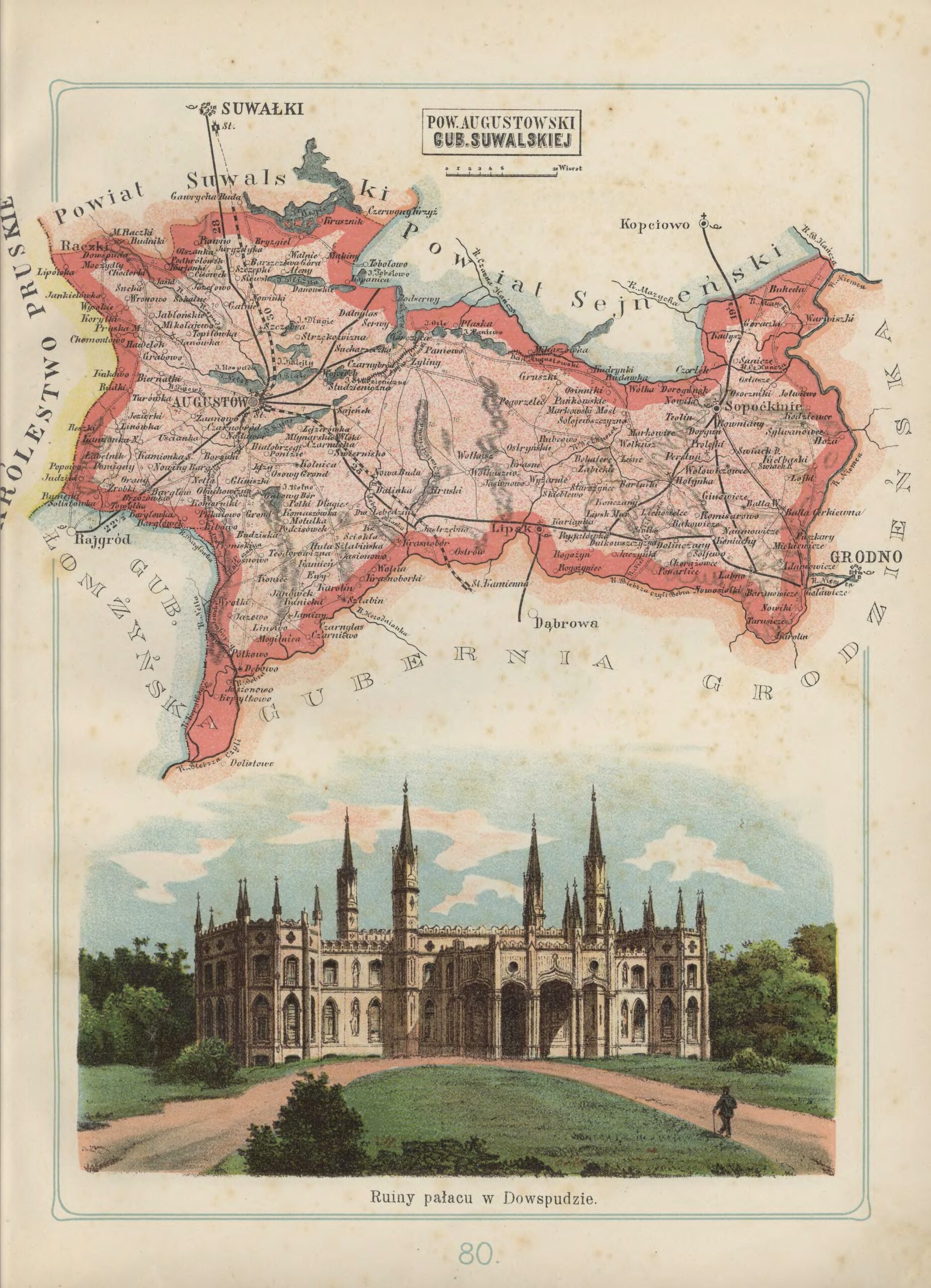
The following parishes were part of the Augustów Powiat at the beginning of the 20th Century: Adamowicze, Augustów, Bargłów Kościelne, Balla Cerkiewna, Holynka, Jaminy, Janówek, Janówka, Krasnybór, Labno, Lipsk, Mikaszówka, Perstuń, Raczki, Rygalówka, Sopoćkinie, Studzieniczna, Sylwanowce, Szczebra, Sztabin (Note: Parishes in italics are currently located in Belarus).

Suwałki Powiat in the Augustów Gubernia – 1907
Józef Michał Bazewicz, Atlas geograficzny ilustrowany Królestwa Polskiego (Litografia B. A. Bukaty, Warsaw, 1907); digital images, Mapywig (http://igrek.amzp.pl/details.php?id=11767131 : accessed 16 March 2026).

The administrative structure of the parishes of Augustów, Bargłów Kościelny, Jaminy, Janówek, Janówka, Krasnybór, Lipsk, Mikaszówka, Rygałówka, Studzieniczna, and Sztabin can be described as follows:

  • 01 Jul 1569-23 Oct 1795: Village, Grodno Powiat, Trakai Voivodeship, Grand Duchy of Lithuania, Polish-Lithuanian Commonwealth
  • 24 Oct 1795-06 Jul 1807: Village, Kreis Wigry, Kammerdepartement Bialystok, Province of New East Prussia, Kingdom of Prussia
  • 07 Jul 1807-08 Jun 1815: Village, Wigry-Sejny Powiat, Łomża Department, Duchy of Warsaw
  • 09 Jun 1815-15 Jan 1816: Village, Wigry-Sejny Powiat, Łomża Department, Congress Kingdom of Poland
  • 16 Jan 1816-06 Mar 1837: Village, Augustów Obwód, Augustów Voivodeship, Congress Kingdom of Poland
  • 07 Mar 1837-10 Nov 1842: Village, Augustów Obwód, Augustów Gubernia, Congress Kingdom of Poland
  • 11 Nov 1842-30 Dec 1866: Village, Augustów Powiat, Augustów Gubernia, Congress Kingdom of Poland
  • 31 Dec 1866 -17 Oct 1915: Village, Augustów Powiat, Suwalki Gubernia, Congress Kingdom of Poland
  • 18 Oct 1915-10 Nov 1918: Village, Suwałki Powiat, German Empire
  • 11 Nov 1918-03 Oct 1939: Village, Augustów Powiat, Białystok Voivodeship, Second Polish Republic
  • 04 Oct 1939-27 Jun 1945: Village, Landkreis Sudauen, Regierungsbezirk Gumbinnen, Province of East Prussia, German Reich
  • 28 Jun 1945-21 Jul 1952: Village: Suwałki Powiat, Białystok Voivodeship, Republic of Poland
  • 22 Jul 1952-31 May 1975: Village, Suwałki Powiat, Białystok Voivodeship, Polish People’s Republic
  • 01 Jun 1975-30 Dec 1989: Village, Suwałki Voivodeship, Polish People’s Republic
  • 31 Dec 1989-30 Dec 1998: Village, Suwałki Voivodeship, Third Polish Republic
  • 31 Dec 1998-Present: Village, Augustów Powiat, Podlaskie Voivodeship, Third Polish Republic

The administrative structure of the parishes of Raczki and Szczebra can be described as follows:

  • 01 Jul 1569-23 Oct 1795: Village, Grodno Powiat, Trakai Voivodeship, Grand Duchy of Lithuania, Polish-Lithuanian Commonwealth
  • 24 Oct 1795-06 Jul 1807: Village, Kreis Wigry, Kammerdepartement Bialystok, Province of New East Prussia, Kingdom of Prussia
  • 07 Jul 1807-08 Jun 1815: Village, Wigry-Sejny Powiat, Łomża Department, Duchy of Warsaw
  • 09 Jun 1815-15 Jan 1816: Village, Wigry-Sejny Powiat, Łomża Department, Congress Kingdom of Poland
  • 16 Jan 1816-06 Mar 1837: Village, Augustów Obwód, Augustów Voivodeship, Congress Kingdom of Poland
  • 07 Mar 1837-10 Nov 1842: Village, Augustów Obwód, Augustów Gubernia, Congress Kingdom of Poland
  • 11 Nov 1842-30 Dec 1866: Village, Augustów Powiat, Augustów Gubernia, Congress Kingdom of Poland
  • 31 Dec 1866 -17 Oct 1915: Village, Augustów Powiat, Suwalki Gubernia, Congress Kingdom of Poland
  • 18 Oct 1915-10 Nov 1918: Village, Suwałki Powiat, German Empire
  • 11 Nov 1918-03 Oct 1939: Village, Augustów Powiat, Białystok Voivodeship, Second Polish Republic
  • 04 Oct 1939-27 Jun 1945: Village, Landkreis Sudauen, Regierungsbezirk Gumbinnen, Province of East Prussia, German Reich
  • 28 Jun 1945-21 Jul 1952: Village: Suwałki Powiat, Białystok Voivodeship, Republic of Poland
  • 22 Jul 1952-31 May 1975: Village, Suwałki Powiat, Białystok Voivodeship, Polish People’s Republic
  • 01 Jun 1975-30 Dec 1989: Village, Suwałki Voivodeship, Polish People’s Republic
  • 31 Dec 1989-30 Dec 1998: Village, Suwałki Voivodeship, Third Polish Republic
  • 31 Dec 1998-Present: Village, Suwałki Powiat, Podlaskie Voivodeship, Third Polish Republic

The administrative structure of the parishes (all of which are currently in Belarus) of Adamowicze/Adamovichi/Адамавічы, Balla Cerkiewna/Bala Solnaja/Баля Сольная, Holynka/Halynka/Галынка, Łabno/Labna/Лабна, Perstuń/Pyerstun′/Перстунь, Sopoćkinie/Sapockin/Сапоцкін, and Sylwanowce/Selivanovtsy/Селіванаўцы can be described as follows:

  • 01 Jul 1569-23 Oct 1795: Village, Grodno Powiat, Trakai Voivodeship, Grand Duchy of Lithuania, Polish-Lithuanian Commonwealth
  • 24 Oct 1795-06 Jul 1807: Village, Kreis Wigry, Kammerdepartement Bialystok, Province of New East Prussia, Kingdom of Prussia
  • 07 Jul 1807-08 Jun 1815: Village, Wigry-Sejny Powiat, Łomża Department, Duchy of Warsaw
  • 09 Jun 1815-15 Jan 1816: Village, Wigry-Sejny Powiat, Łomża Department, Congress Kingdom of Poland
  • 16 Jan 1816-06 Mar 1837: Village, Augustów Obwód, Augustów Voivodeship, Congress Kingdom of Poland
  • 07 Mar 1837-10 Nov 1842: Village, Augustów Obwód, Augustów Gubernia, Congress Kingdom of Poland
  • 11 Nov 1842-30 Dec 1866: Village, Augustów Powiat, Augustów Gubernia, Congress Kingdom of Poland
  • 31 Dec 1866 -17 Oct 1915: Village, Augustów Powiat, Suwalki Gubernia, Congress Kingdom of Poland
  • 18 Oct 1915-10 Nov 1918: Village, Suwałki Powiat, German Empire
  • 11 Nov 1918-03 Oct 1939: Village, Augustów Powiat, Białystok Voivodeship, Second Polish Republic
  • 04 Oct 1939-27 Jun 1945: Village, Landkreis Sudauen, Regierungsbezirk Gumbinnen, Province of East Prussia, German Reich
  • 28 Jun 1945-Present: Village, Hrodna Region, Belarus

Copyright © 2026 by Stephen J. Danko

Posted in Daily Journal | Leave a comment

Lists of Inhabitants and Subjects in the Current Voivodeship of Podkarpackie

For the past few months, Michał Ciemała has been indexing lists of inhabitants and subjects in the current voivodeship of Podkarpackie from the 18th century and earlier (Spisy mieszkańców oraz poddanych, XVIII wiek i wcześniej). These lists include Pilzno County of the Sandomierz Voivodeship, Biecz County of the Kraków Voivodeship and the Sanok and Przemyśl Lands of the Russian Voivodeship.

The indexes include the List of subjects of the villages of Nienadowa and Hucisko Nienadowskie, 1773, which includes the name of my 4th great grandfather, Józef Dańko who was born in about 1717 and who died on 26 Oct 1787 in Nienadowa (see line 25).

Note: In these indexes, the village indexed as Nienadowa is currently known as Nienadowa Dolna, and the village indexed as Hucisko Nienadowskie is currently known as Nienadowa Górna (see the entry for Nienadowa in the Słownik Geograficzny Królestwa Polskiego i Innych Krajów Słowiańskich.)

Copyright © 2026 by Stephen J. Danko

Posted in Daily Journal | Comments Off on Lists of Inhabitants and Subjects in the Current Voivodeship of Podkarpackie

The Polish Village of Dzierżanowo (Szwelice Parish)

The Słownik Geograficzny Królestwa Polskiego i Innych Krajów Słowiańskich (Geographical Dictionary of the Kingdom of Poland and other Slavonic Countries) includes multiple entries for Polish villages called Dzierżanowo. One of these is currently located in Maków Powiat and belongs to the Szwelice Parish.

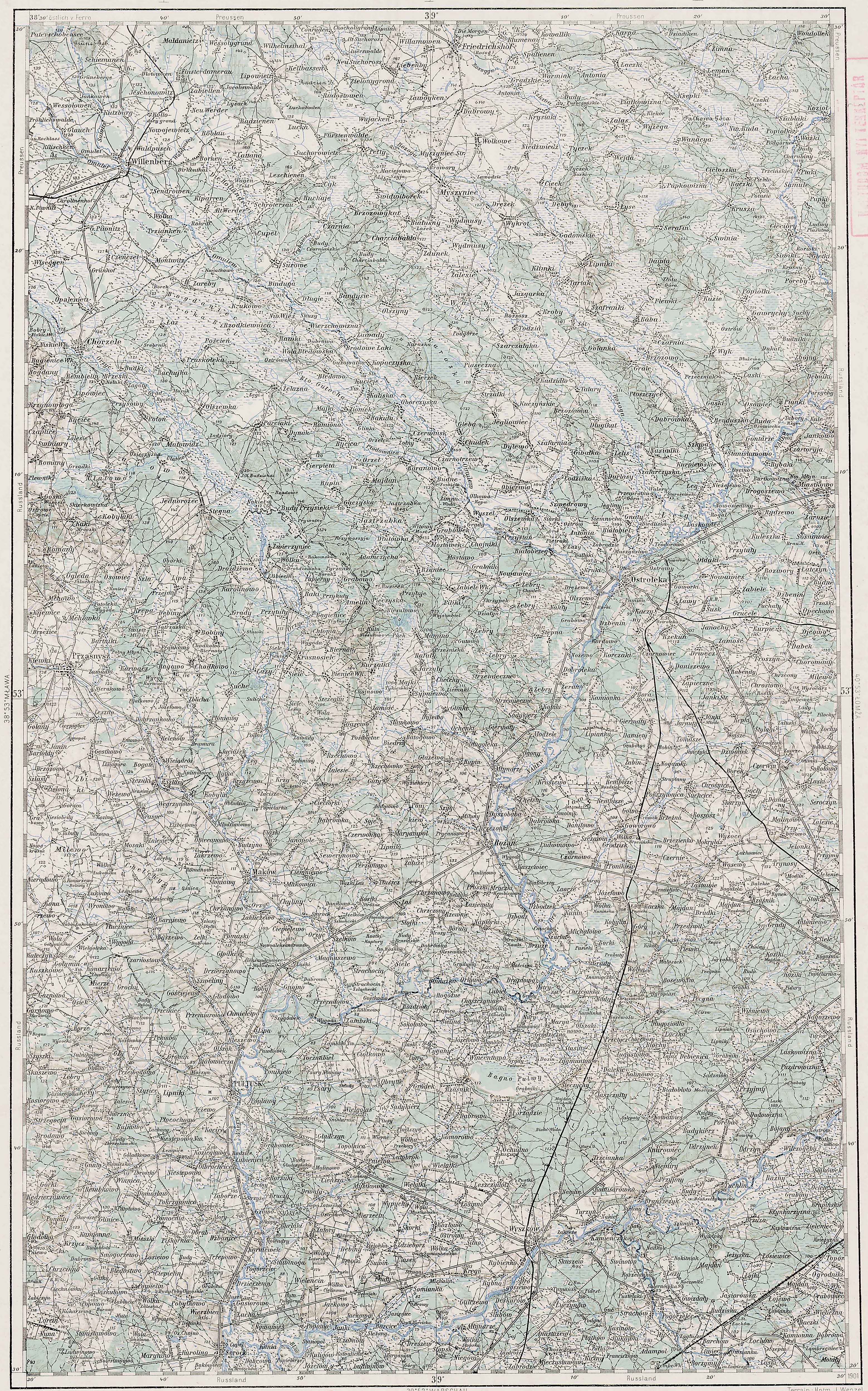
Dzierżanowo and Surrounding Area – 1910

Third Military Mapping Survey of Austria-Hungary (ELTE Faculty of Informatics,
Institute of Cartography and Geoinformatics); digital images, Lazarus ELTE
(http://lazarus.elte.hu/hun/digkonyv/topo/200e/39-53.jpg: accessed 20 December 2025)

Source: Sulmierski, Filip, Bronisław Chlebowski, and Władysław Walewski, eds., Słownik Geograficzny Królestwa Polskiego i Innych Krajów Słowiańskich (Geographical Dictionary of the Kingdom of Poland and other Slavonic Countries) – Warsaw 1881, Volume II, page 277.

Click on the link for a PDF copy of the the Słownik Geograficzny entry for Dzierżanowo. Translated from the Polish, the entry reads:

3.) Dzierżanowo, a village and folwark [a large manorial farm], situated on the Pełta River, in Maków powiat, Karniewo gmina, Szwelice parish. In 1827, there were 24 houses and 224 inhabitants. See also Czarnostowo.

Copyright © 2026 by Stephen J. Danko
Posted in Daily Journal | Comments Off on The Polish Village of Dzierżanowo (Szwelice Parish)

The Dictionary of Polish Place Names – Czarnostów/Czarnostowo (Szwelice Parish)

The Dictionary of Polish Place Names (Nazwy Miejscowe Polski) explains the origin of place names in Poland and details how the place name changed over time.

Volume III of Nazwy Miejscowe Polski lists one place called Czarnostów which belongs to the Szwelice parish.

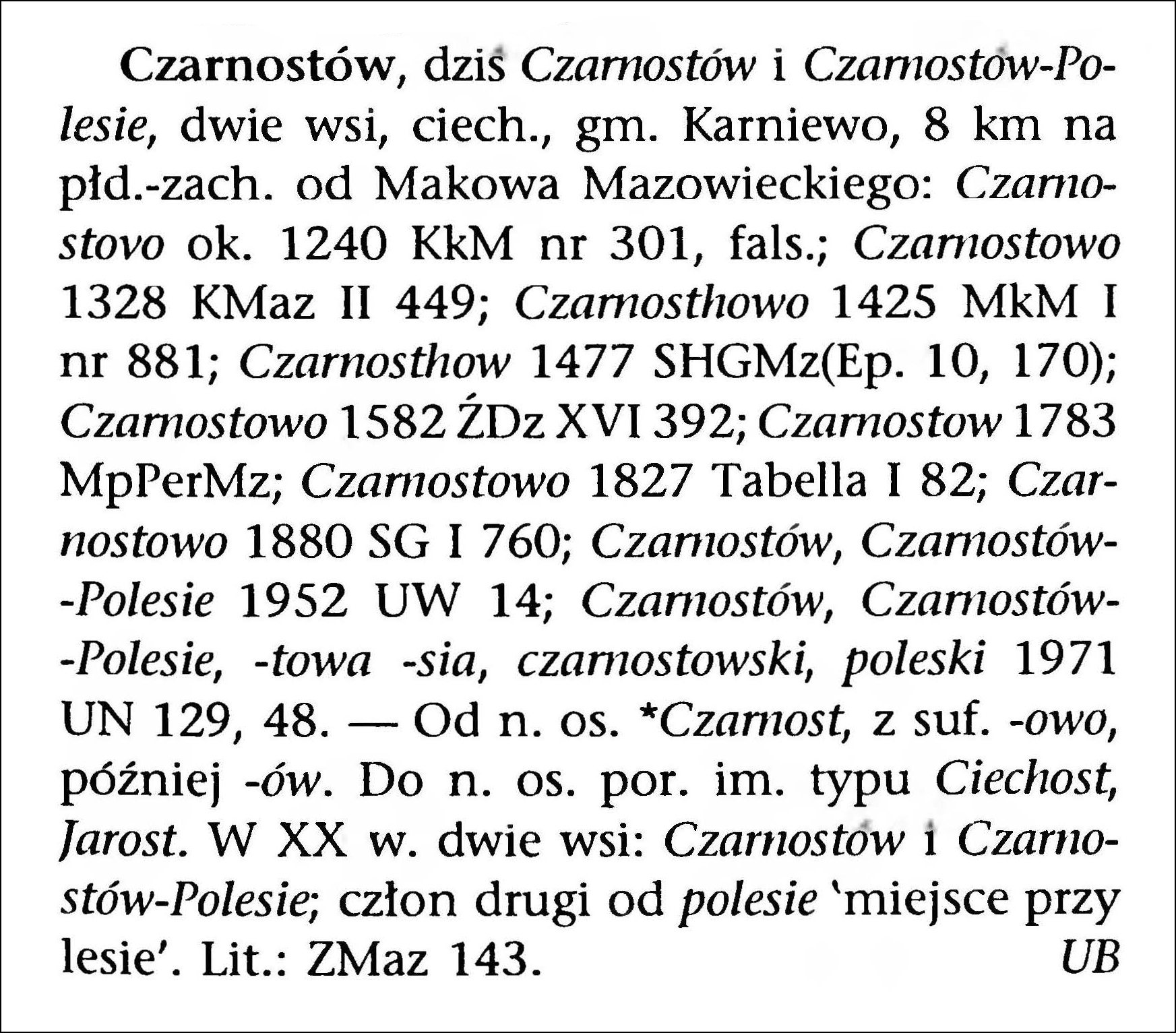
Nazwy Miejscowe Polski indicates that Czarnostów was two villages in the Karniewo Gmina, Ciechanów Voivodeship in the years 1975-1998 and was located 8 kilometers southwest of Maków Mazowiecki. Mentions of the village include: Czarnostovo in about 1240 (forgery); Czarnostowo in 1328, Czarnosthowo in 1425, Czarnosthow in 1477, Czarnostowo in 1582, Czarnostow in 1783, Czarnostowo in 1827, Czarnostowo in 1880, Czarnostów, Czarnostów-Polesie in 1952, and Czarnostów, Czarnostów-Polesie, -towa -sia, czarnostowski, poleski in 1971.

The name Czarnostów is from the name of a settlement *Czarnost, with the suffix -owo, later -ów. For the name of the settlement, compare names of the type Ciechost, Jarost. In the 20th century there are two villages: Czarnostów and Czarnostów-Polesie; the second part of Czarnostów-Polesie comes from the word polesie, meaning ‘place near the forest’.

Source: Rymut, Kazimierz, ed., Nazwy Miejscowe Polski (Place Names of Poland) – Krakow 1997, Volume II, page 189.

Click the link for a PDF copy of the Nazwy Miejscowe Polski entry for Czarnostów. Translated from the Polish, the entry reads:

     Czarnostów, today Czarnostów and Czarnostów-Polesie, two villages, Ciechanów voivodeship, Karniewo gmina, 8 kilometers southwest of Maków Mazowiecki: Czarnostovo about 1240 KkM no. 301, forgery; Czarnostowo 1328 KMaz II 449; Czarnosthowo 1425 MkM I no. 881; Czarnosthow 1477 SHGMz(Ep. 10, 170); Czarnostowo 1582 ŹDz XVI 392; Czarnostow 1783 MpPerMz; Czarnostowo 1827 Tabella I 82; Czarnostowo 1880 SG I 760; Czarnostów, Czarnostów-Polesie 1952 UW 14; Czarnostów, Czarnostów-Polesie, -towa -sia, czarnostowski, poleski 1971 UN 129, 48. – From the name of a settlement *Czarnost, with the suffix -owo, later -ów. For the name of the settlement, compare names of the type Ciechost, Jarost. In the 20th century, two villages: Czarnostów and Czarnostów-Polesie; the second part from polesie ‘place near the forest’. Lithuanian: ZMaz 143.     Urszula Bijak

Copyright © 2026 by Stephen J. Danko

Posted in Daily Journal | Comments Off on The Dictionary of Polish Place Names – Czarnostów/Czarnostowo (Szwelice Parish)

The Polish Village of Czarnostowo/Czarnostów (Szwelice Parish)

The Słownik Geograficzny Królestwa Polskiego i Innych Krajów Słowiańskich (Geographical Dictionary of the Kingdom of Poland and other Slavonic Countries) includes one entry for the Polish village of Czarnostowo, currently three villages in Maków Powiat called Czarnostów and Czarnostów Polesie, and Kolonia Czarnostów Polesie.

Czarnostowo and Surrounding Area – 1910

Third Military Mapping Survey of Austria-Hungary (ELTE Faculty of Informatics,
Institute of Cartography and Geoinformatics); digital images, Lazarus ELTE
(http://lazarus.elte.hu/hun/digkonyv/topo/200e/39-53.jpg: accessed 20 December 2025)

Source: Sulmierski, Filip, Bronisław Chlebowski, and Władysław Walewski, eds., Słownik Geograficzny Królestwa Polskiego i Innych Krajów Słowiańskich (Geographical Dictionary of the Kingdom of Poland and other Slavonic Countries) – Warsaw 1880, Volume I, page 760.

Click on the link for a PDF copy of the the Słownik Geograficzny entry for Czarnostowo. Translated from the Polish, the entry reads:

     Czarnostowo, a village and manor on the Sona River, Maków powiat, Karniewo gmina, Szwelice parish. In 1827, there were 28 houses and 209 inhabitants. The Czarnostowo estate consists of the Czarnostowo manor and the villages of Czarnostowo, Dzierżanowo, and Szwelice; 77 versts [1 verst = 1.07 kilometers] from Łomża, 8 versts from Maków, 13 versts from Pułtusk, and 9 versts from the Narew River. The area is 3,282 mórgs [Gerald Ortell’s book on Polish Parish Records states that in the Russian partition 1 mórg = 1.388 acres], specifically: arable land and gardens 853 mórgs, meadows 182 mórgs, forest 2,209 mórgs, wasteland and building plots 38 mórgs. Four-field crop rotation. 4 brick buildings, 20 wooden buildings. A steam mill processing approximately 12,000 bushels of grain annually; a sawmill, threshing machine and chaff cutter, powered by steam; a windmill, as well as deposits of marl and limestone. The village of Czarnostowo has 44 settlements and 341 mórgs of land; the village of Dzierżanowo has 12 settlements and 252 morgs of land; the village of Szwelice has 36 settlements and 779 mórgs of land. Aleksander Palmirski

Copyright © 2026 by Stephen J. Danko

Posted in Daily Journal | Comments Off on The Polish Village of Czarnostowo/Czarnostów (Szwelice Parish)

The Dictionary of Polish Place Names – Gociejewo (Szwelice Parish)

The Dictionary of Polish Place Names (Nazwy Miejscowe Polski) explains the origin of place names in Poland and details how the place name changed over time.

Volume III of Nazwy Miejscowe Polski lists one place called Gociejewo which belongs to the Szwelice parish.

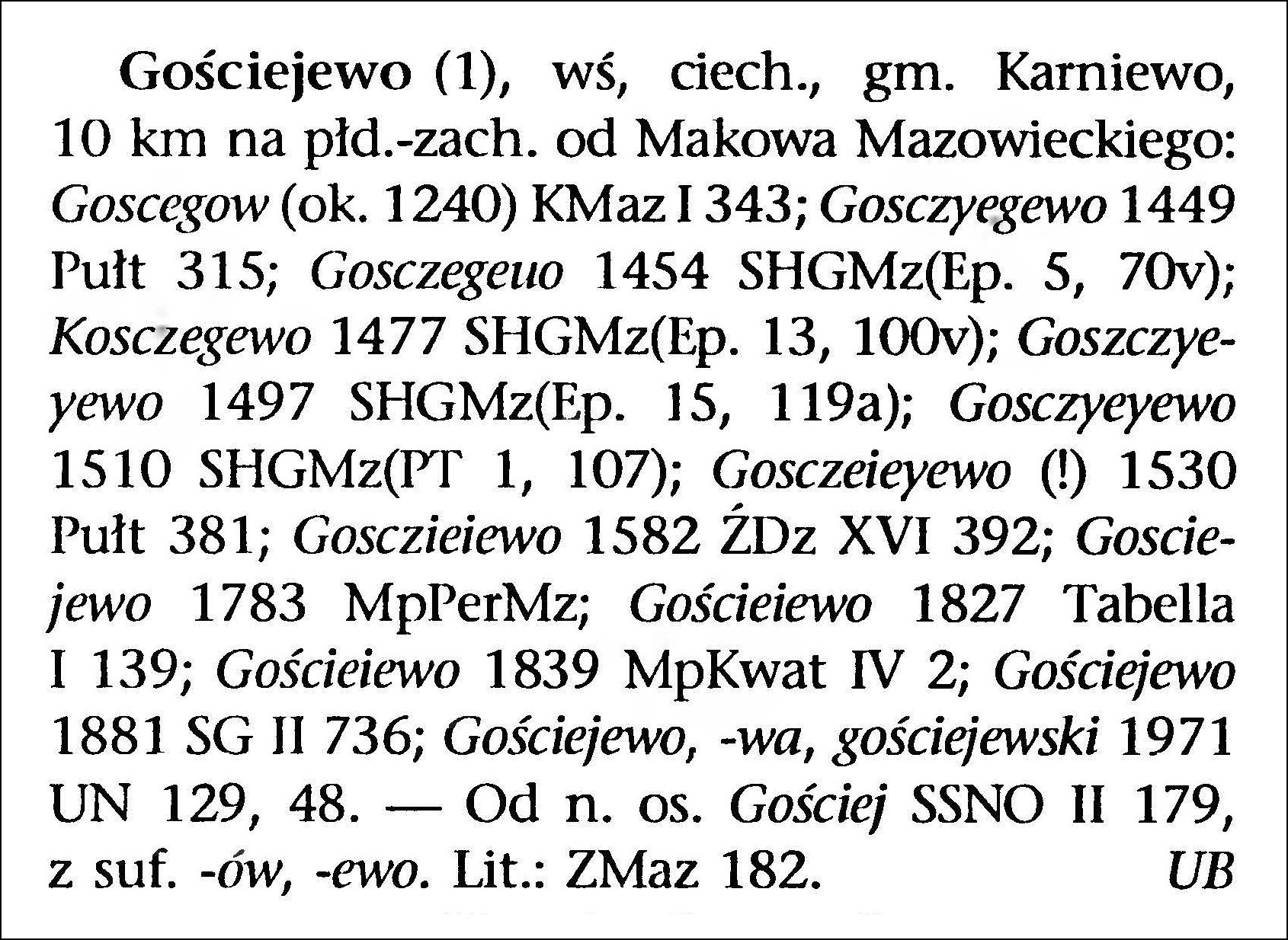
Nazwy Miejscowe Polski indicates that Gociejewo was in the Karniewo Gmina, Ciechanów Voivodeship in the years 1975-1998 and was located 10 kilometers southwest of Maków Mazowiecki. Mentions of the village include: Goscegow in (about 1240), Gosczyegewo in 1449, Gosczegeuo in 1454, Kosczegewo in 1477, Goszczyeyewo in 1497, Gosczyeyewo in 1510, Gosczeieyewo (!) in 1530, Gosczieiewo in 1582, Gosciejewo in 1783, Gościeiewo in 1827, Gościeiewo in 1839, Gościejewo in 1881, and Gościejewo, -wa, gościejewski in 1971.

The name of Gościejewo is from the name of a settlement Gościej, with suffixes -ów, -ewo.

Source: Rymut, Kazimierz, ed., Nazwy Miejscowe Polski (Place Names of Poland) – Krakow 1999, Volume III, page 276.

Click the link for a PDF copy of the Nazwy Miejscowe Polski entry for Gościejewo. Translated from the Polish, the entry reads:

     Gościejewo (1), village, Ciechanów voivodeship, Karniewo gmina [in the years 1975-1998], 10 kilometers southwest of Maków Mazowiecki: Goscegow (about 1240) KMaz I 343; Gosczyegewo 1449 Pult 315; Gosczegeuo 1454 SHGMz(Ep. 5, 70v); Kosczegewo 1477 SHGMz(Ep. 13, 100v); Goszczyeyewo 1497 SHGMz(Ep. 15, 119a); Gosczyeyewo 1510 SHGMz(PT 1, 107); Gosczeieyewo (!) 1530 Pułt 381; Gosczieiewo 1582 ŹDz XVI 392; Gosciejewo 1783 MpPerMz; Gościeiewo 1827 Tabella I 139; Gościeiewo 1839 MpKwat IV 2; Gościejewo 1881 SG II 736; Gościejewo, -wa, gościejewski 1971 UN 129, 48. – From the name of a settlement Gościej SSNO II 179, with suffixes -ów, -ewo. Lithuanian: ZMaz 182.     Urszula Bijak

Copyright © 2026 by Stephen J. Danko
Posted in Daily Journal | Comments Off on The Dictionary of Polish Place Names – Gociejewo (Szwelice Parish)

The Polish Village of Gościejewo (Szwelice Parish)

The Słownik Geograficzny Królestwa Polskiego i Innych Krajów Słowiańskich (Geographical Dictionary of the Kingdom of Poland and other Slavonic Countries) includes one entry for the same Polish village of Gościejewo, currently in Maków Powiat.

Gosciejewo and Surrounding Area – 1910

Third Military Mapping Survey of Austria-Hungary (ELTE Faculty of Informatics,
Institute of Cartography and Geoinformatics); digital images, Lazarus ELTE
(http://lazarus.elte.hu/hun/digkonyv/topo/200e/39-53.jpg: accessed 20 December 2025)

Click on the link for a PDF copy of the Słownik Geograficzny entries for Gościejewo.

Translated from the Polish, the first entry reads:

     Gościejewo, a village on the Pełta River, Maków powiat, Karniewo gmina, Szwelice parish. In 1827, there were 9 houses and 76 inhabitants.

Translated from the Polish, the second entry reads:

     Gościejewo 1.) (mentioned in documents as Goszcegou), a village in the Maków powiat, Szwelice parish. Mentioned in a 13th-century document among the estates of the Płock church. In 1582 it had 8 łans [literally “field,” a unit of land measurement used in Poland since the 13th century]. In the 1827 census, it is listed as a government-owned village.

Copyright © 2026 by Stephen J. Danko
Posted in Daily Journal | Comments Off on The Polish Village of Gościejewo (Szwelice Parish)

The Polish Village of Szlasy-Złotki (Szwelice Parish)

The Słownik Geograficzny Królestwa Polskiego i Innych Krajów Słowiańskich (Geographical Dictionary of the Kingdom of Poland and other Slavonic Countries) includes several entries for Polish villages called Szlasy. The fourth entry is for the Polish village of Szlasy-Złotki, currently in Maków Powiat, belonging to the parish of Szwelice.

Szlasy-Złotki and Surrounding Area – 1910

Third Military Mapping Survey of Austria-Hungary (ELTE Faculty of Informatics,
Institute of Cartography and Geoinformatics); digital images, Lazarus ELTE
(http://lazarus.elte.hu/hun/digkonyv/topo/200e/39-53.jpg: accessed 20 December 2025)

Source: Chlebowski, Bronisław and Władysław Walewski, eds., Słownik Geograficzny Królestwa Polskiego i Innych Krajów Słowiańskich (Geographical Dictionary of the Kingdom of Poland and other Slavonic Countries) – Warsaw 1890, Volume XI, page 928.

Click on the link for a PDF copy of the Słownik Geograficzny entry for Szlasy-Złotki. Translated from the Polish, the entry reads:

     4.) Szlasy Złotki, Maków powiat, Smrock gmina, Szwelice parish. Small landowners live here.

Copyright © 2026 by Stephen J. Danko

Posted in Daily Journal | Comments Off on The Polish Village of Szlasy-Złotki (Szwelice Parish)

The Polish Village of Zelki-Dąbrowe (Szwelice Parish)

The Słownik Geograficzny Królestwa Polskiego i Innych Krajów Słowiańskich (Geographical Dictionary of the Kingdom of Poland and other Slavonic Countries) includes one entry for the Polish village of Zelki-Dąbrowe currently in Maków Powiat, belonging to the parish of Szwelice.

According to the Dictionary of Polish Place Names entry for the village of Pomaski Wielkie, the village of Zelki-Dąbrowe was once known as Pomaski-Zelki.

Zelki-Dąbrowe and Surrounding Area – 1910

Third Military Mapping Survey of Austria-Hungary (ELTE Faculty of Informatics,
Institute of Cartography and Geoinformatics); digital images, Lazarus ELTE
(http://lazarus.elte.hu/hun/digkonyv/topo/200e/39-53.jpg: accessed 20 December 2025)

Source: Chlebowski, Bronisław, ed., Słownik Geograficzny Królestwa Polskiego i Innych Krajów Słowiańskich (Geographical Dictionary of the Kingdom of Poland and other Slavonic Countries) – Warsaw 1895, Volume XIV, page 565.

Click on the link for a PDF copy of the the Słownik Geograficzny entry for Zelki-Dąbrowe. Translated from the Polish, the entry reads:

     Zelki Dąbrowne, in the year 1582 Zelki Dabrowne, a village in the Maków powiat, Smrock gmina, Szwelice parish. It is inhabited by minor nobility. In 1827, it had 13 houses and 76 inhabitants. In 1582, the village had 3 peasant land units.

Copyright © 2026 by Stephen J. Danko
Posted in Daily Journal | Comments Off on The Polish Village of Zelki-Dąbrowe (Szwelice Parish)

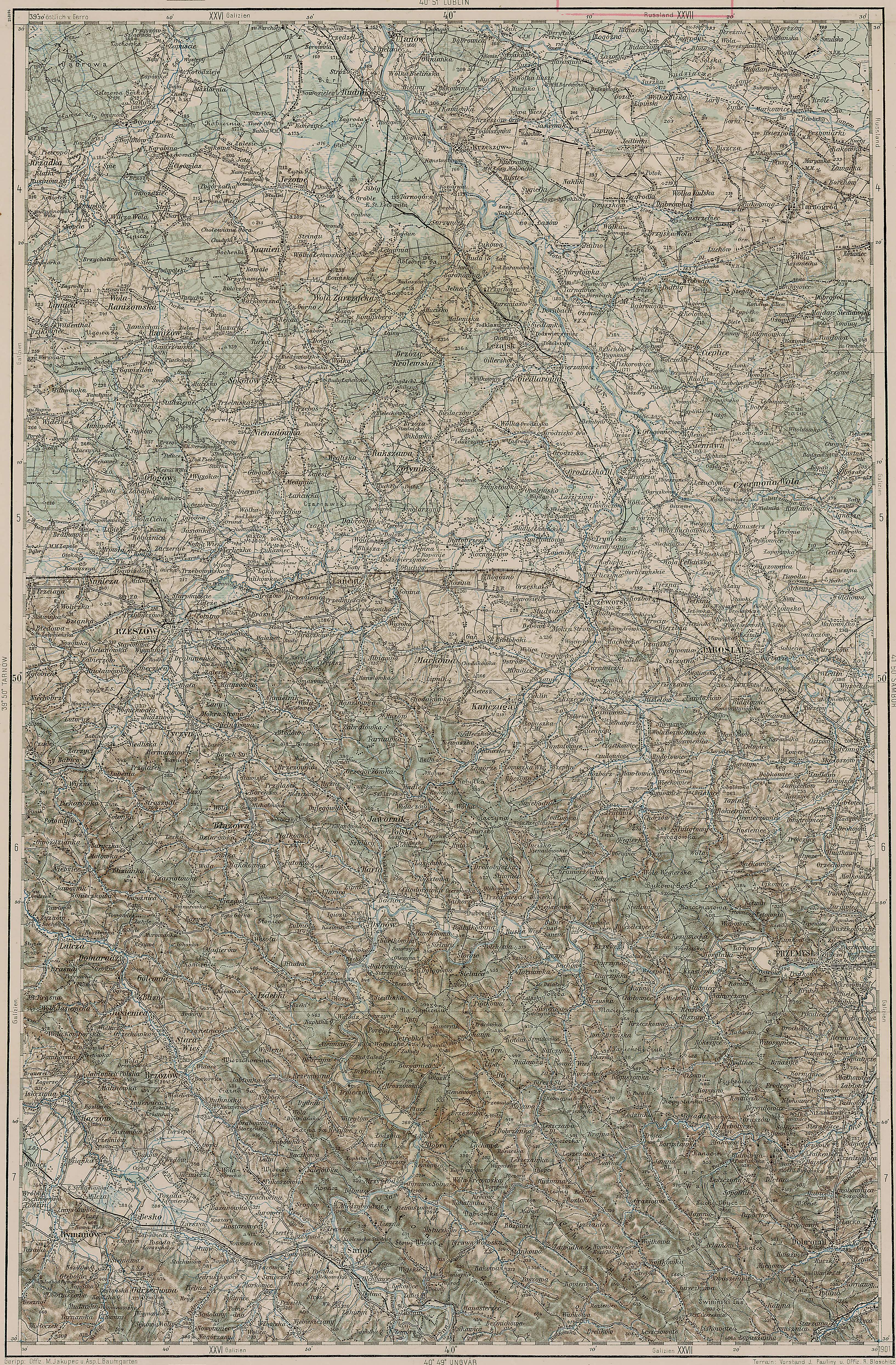
The Dictionary of Polish Place Names – Pomaski Wielkie (Szwelice Parish)

The Dictionary of Polish Place Names (Nazwy Miejscowe Polski) explains the origin of place names in Poland and details how the place name changed over time.

Volume IX of Nazwy Miejscowe Polski lists one place called Pomaski Wielkie. This entry is for a village which belongs to the Szwelice parish.

Nazwy Miejscowe Polski indicates that Pomaski Wielkie was in the Szelków Gmina, Ostrołęka Voivodeship in the years 1975-1998 and was located 5.5 kilometers southwest of Maków Mazowiecki. Mentions of the village include: “The Duke gave Strachenycze to the said Pomaskys, heirs of Wełen, 10 manors around his area; heir of Pomasky in (1414-25) 1456, Pomasky in 1427, Pomasky in 1436 and 1539, Pomasky in 1483, Pomassky in 1495, Pomaski in 1514, Pomaski in 1582, Pomaski w. in 1783, Pomaski wielkie in 1827, Pomaski Wielkie in 1887, and Pomaski Wielkie, -mask -kich, pomaskowski in 1971.

The name of the village of Pomaski comes from the personal name Pomaska ​​(: pomazać ‘to anoint’), in the first person plural. From the 18th century, the name appears with a differentiating element: the adjective wielki [great]. Pomaski is the name of a so-called noble district in the area of ​​which villages with the following names were established: Pomaski-Jałbrzyki, Pomaski-Kownaty, Pomaski-Michały, Pomaski-Sikuty, Pomaski-Zelki (today Zelki Dąbrowne) and Pomaski Wielkie.

Source: Rymut, Kazimierz and Barbara Czopek-Kopciuch, eds., Nazwy Miejscowe Polski (Place Names of Poland) – Krakow 2013, Volume IX, pages 136-137.

Click the link for a PDF copy of the Nazwy Miejscowe Polski entry for Pomaski Wielkie. Translated from the Polish, the entry reads:

     Pomaski Wielkie, a village in the Ostrołęka voivodeship, Szelków gmina, 5.5 kilometers southwest of Maków Mazowiecki: “The Duke gave Strachenycze to the said Pomaskys, heirs of Wełen, 10 manors around his area; heir of Pomasky (1414-25) 1456 SHGMz (MK 3, 86 and 109); Pomasky 1427 MkM I nr 535; Pomasky 1436, 1539 Matr IV/1, nr 6365; Pomasky 1483 SHGMz (MK 6, 162); Pomassky 1495 SHGMz (Ep. 15, 49v-50); Pomaski 1514 SHGMz (PT 1, 88); Pomaski 1582 ŹDz XVI 392; Pomaski w. 1783 MpPerMz; Pomaski wielkie 1827 Tabella II 107; Pomaski Wielkie 1887 SG VIII 737; Pomaski Wielkie, -mask -kich, pomaskowski 1971 UN 129, 49. – From the personal name Pomaska ​​(: pomazać ‘to anoint’), in the first person plural, compare the first record. From the 18th century, the name appears with a differentiating element from the adjective wielki [great]. Pomaski is the name of a so-called noble district in the area of ​​which villages with the following names were established: Pomaski-Jałbrzyki, Pomaski-Kownaty, Pomaski-Michały, Pomaski-Sikuty, Pomaski-Zelki (today Zelki Dąbrowne) and Pomaski Wielkie. Lithuanian: ZMaz 303.     Urszula Bijak

Copyright © 2026 by Stephen J. Danko
Posted in Daily Journal | Comments Off on The Dictionary of Polish Place Names – Pomaski Wielkie (Szwelice Parish)